Tuesday, October 1, 2013

It's October, Time To Go On Mushrooms Picking

            Many people like walking in the woods, picking berries and mushrooms. But not everyone is convinced that the collected berries and mushrooms are edible. If edible berries are easy to remember, you're constantly in doubt with mushrooms: to take it or do not? That is the question. And the answer is always simple: if you do not know this mushroom, you are not sure, in doubt - do not take it! I go not often for mushrooms. They do not grow continuously, the harvest depends on the rain, night temperatures, sunshine and the number of mushroom hunters per square meter.

'When fall time comes, I'm always glad
To go mushroom hunting with my friend
Walking in the woods on a cool, fall day
Taking in the beauty of God's display
It's just like a treasure hunt to me
Searching for those gems amongst the leaves
What a thrill, when one I think I spy
But it's just a leaf, so I pass on by
Then at last, I spot a beauty
And by it's side, three little cuties
A pinch to the stems, then placed in my sack
I hope to fill it till there's no more slack'

Here some edible mushrooms were picked this fall.


First on the list is a cep, or white cep (Boletus edulis or Boletus pinophilus), the most valuable one (in the center). His hat is light or dark brown (if growing in pine forests), light brown foot. How to use it? Fresh ceps can be fried, pickled, dried for winter.
The second one is an orange-cap boletus or aspen mushroom ( Leccinum aurantiacum), beautiful mushroom, conspicuous from a distance, unless of course, it is not hiding in the grass! It has an orange-cap (on the left of this photo). Orange-cap boletus grows in deciduous forests, under the aspens, in the grass. These fresh mushrooms can be fried or boiled, you can pickle or preserve, can be dried for winter.
Here is another boletus that often comes across to mushroom hunters in the woods (top, on the left). 


This is saffron milk cap (Boletus Lactarius). Saffron milk cap mushroom, as well as milk mushroom, belong to the group of mushrooms those are necessary to boil before use, pickling or salting.The mushrooms on the right are honey agarics.
I love honey agarics mushrooms (Armillariella mellea). Funny groups can be found on cutting areas, on stumps and trunks of trees. Honey agarics choose birch stumps, they grow up and destroy the base.
In my garden some years ago an old birch tree was cut down, but not completely, and high stump remained. Over the years, honey agarics mushrooms settled on the stump (how did mycelium get there?). 


Yesterday they were not there; and today the whole stump is strewn with young mushrooms. I fry them or cook soup, but I basically freeze them for winter. Here is a plate of fresh fried honey agarics, dressing with tomatoes, cucumbers and parsley. 


Bon appetite!

'Wild Mushrooms cooked in sauce
garlic, spices and wine
expensive olive oil
adding capers now
simmer until done
Wild food
Great!!'

Tuesday, September 24, 2013

The Miracle of Nature In the Dragon Cave, Majorca

            After traveling to the Mondrago Nature Park I decided to look at the Dragon Cave, which is located on the east coast of the Majorca island. Having early arriving I has got into the first group of visitors. I must say that is not allowed to go down into the cave by one and visitors were organized into groups.
The cave entrance was the deepening on the surface, then you go into a dark hole and see the steps leading down under the ground to a depth of 27
m. Along the walkway railings are installed, stages are lighted and tour guides were on descent turnings.


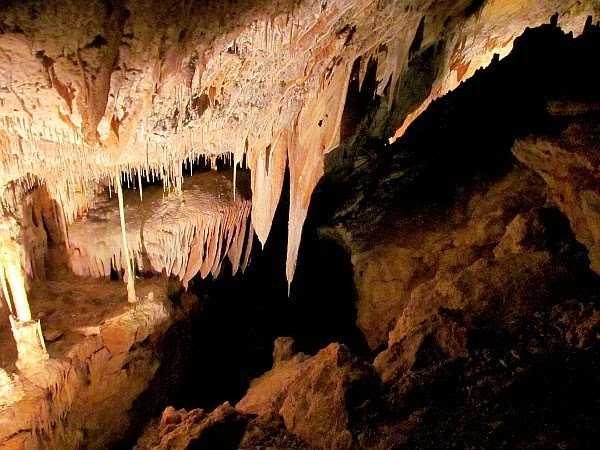
The first impression of the cave was: I've got into a magical land, with a magical forest, magical people and their king. 

 
In nature, water gets into the cave slowly with rare drops through the thickness of the earth. The drops wash out calcium of the rock and stalactites are growing from the top down.
Dripping on the cave floor the water brings calcium crystals those begin to emerge in the stalagmites those are rising from the bottom up. Stalagmites are thicker than stalactites, because the water sprayes and scatters crystals.
This miracle of nature grows very slowly, hundreds and thousands of years and if the cave is not very high, the stalagmites and stalactites grow together over time. In the Dragon cave stalactites and stalagmites are lit of different colors, from orange to cool white. 


When we descended down greatly, it became wet and a bit chilly. Then I remembered the advice to take a sweater or a jacket. There in depth on the right I could see small blue lakes with crystal clear water and stunning reflection of "a magic forest" in the water. I could not determine the depth of these small lakes, so the water was very clear.


On the left I saw "branches and trunks" sought to away, forming niches and arches where it was possible to see the other "plants along the road." The lighting in the cave emphasized the shapes and patterns of stalactites and stalagmites.


Going down lower and lower, I tried to take pictures of interesting colors and shapes combinations to show you the wonder of nature in this cave. Nature is generous to a surprising, not only on surface but also in depth.


Finally, a huge underground lake appeared at the bottom of the cave. The water color was turquoise, a lake was deep, with pure distilled water. I was told that its depth is 20 m.
All visitors were invited to the amphitheater at the lake and the show began. When lights had gone out, the sounds of music were heard in the darkness and silence. At first I could not see anything, but then the boat lit garland lights appeared from the far end of the lake. Music floated over the water, and I could see the musicians in a boat. It was an amazing musical concert under the ground at a depth of 27 meters!


After the concert, all interested visitors could ride on the lake in boats. The return climb up was not easy, but there were places to rest and take pictures, the exit up was in elsewhere. 


I came out to the surface a few meters from the entrance to the cave. A park with flowers, palm trees and cactus was around.


Here is my video about Dragon cave:


Thursday, September 19, 2013

Natural Park In the Majorca Island

        My vacations in Majorca island have finished. I had pleasant days of the sun and the sea. In one of hot days I went to the Natural park of Mondrago, which is located to the south-east on the rocky shores of the Mediterranean. 


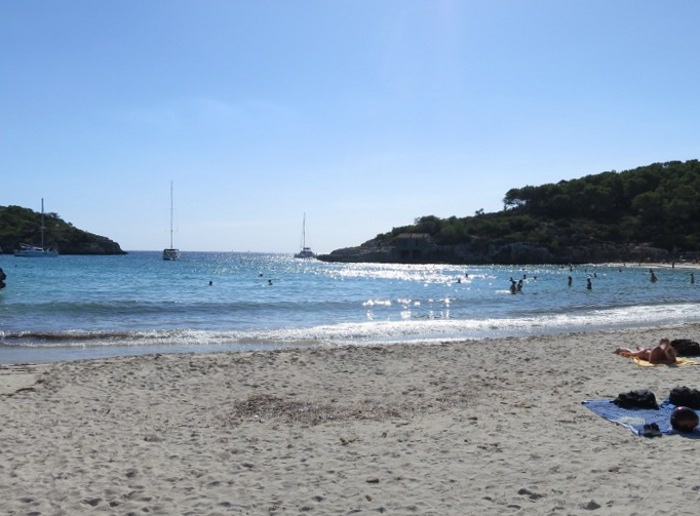
A lot of tourists come to the Mondrago park just to sunbathe and swim. There are two beautiful beaches in the park, with pure white sand and crystal clear water. To reach the beach from the parking they need to overcome a few tens meters of the narrow path along the rocky cliff. 


Although there is no fence along the walkway it does not scare the tourists. They boldly go with baby carriages, inflatable rafts, umbrellas and towels to enjoy the beach. I also passed with the others along the cliff to the beach, bathed in the warm emerald blue water and went to the park. The paths in the park are rocky, steeply rise up and come down. 

 
Everywhere you can see the impact of strong winds and sun on the trees. The soil is poor on the coast, limestone and fertile soil is very thin here. Environmental conditions, such as lack of rain water, the heavy sunshine, the salt in the air and strong winds determine the plant species that can survive. 


They are plants with small, stiff leaves to limit water loss due to evaporatation: rosemary (Rosemarinus officalis), mastic tree (Pistacia lentiscus) and Savin (Juniperus phoenicea), pines (Pinus halepensis) and gatova or broom (Genista lucida). I liked the pine trees those lie along the shoreline, twisted by strong winds. I also found pine trees, growing as a natural bonsai, without effort of a man.


Despite the harsh conditions of survival, I saw herbs, shrubs with berries and I found amazing succulents on the dried swamp.Cones have grown on pines, berries reddened on cotoneasters, seeds matured on herbs.


 Young sprouts of pine trees were creeping along the sand beach. Life goes on! 


Here is my video about Natural park Mondrago: