Monday, October 15, 2018

Garden Bloggers' Day in Mid-October

It's already mid-October, summer's gone and the plants in my garden are preparing to overwinter. Some of them faded but others are in their last bloom. I love this decorative bush Symphoricarpos albus or Snowberry. It blooms in summer with small pink flowers that make all pollinators happy. When comes autumn snow-white round waxy berries appear and persist until spring on Snowberry branches. Birds, small mammals eat them during winter cold months.


This Hydrangea paniculata that just a month ago was in creamy-pink colors now is brown and semi-dry. Soon at the end of the month I will cut dry flowers of hydrangea and will use them to shelter tulips from the frost.


There are blooms in the greenhouse, where temperature is higher than +14 C outside. This clematis 'Blue angel' continues flowering and the last bud of water lily is opening (I moved the basket with water lily in the greenhouse).


The paths are to be cleaned because of faded slippery leaves of Virginia creeper and apples that fall down time to time. It's my job for next days. Under the apple tree there is a sack full of red apples. Guess, how many apple pies I have to cook? :-)


Some wild plants as Solidago (Goldenrod) and Topinambur (The Jerusalem artichoke) grow behind the garden fence and look nice under the autumn sky.


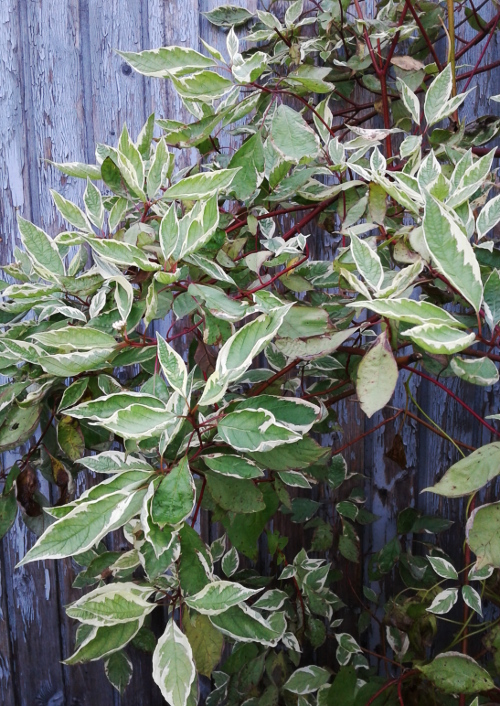
The bushes are still green as this Cornus alba variegata. The evergreen rhododendrons are OK in autumn rainy weather. This one is 'Helsinki University'. Yesterday I feed all rhododendrons with potassium and magnesium for better wintering.


I finish this post showing you the last flower of the rose 'Summer wind', that grows the second year in my garden and is healthy and hardy to our climate.


What glad you in this season?


Saturday, October 6, 2018

Skansen: Allotments


I continue to tell you about the open-air museum Skansen situated on the island in the center of Stockholm, the capital of Sweden. There you can find objects reflecting the life of people of northern Europe in the 19 - 20th centuries: whole streets of wooden houses, sheds, mills, churches, ponds, various workshops, the rose garden, animal farms with cows, horses, geese, hens, etc. It's joy and pleasure for adults and children.
Of course it was interesting to see the garden allotments of the early 20th century. These ones appeared in Sweden immediately after the First World War. Around the turn of the 1900th century associations for letting allotments to working-class families were established. During the First World War there were shortages of potatoes and other staple foods in the cities.


Several such allotments were allocated in the vicinity of the city park Tanto, but later the number of garden plots increased, as people enthusiastically began to cultivate not only potatoes, but also other vegetables, and soon flowers appeared there.


Then it was legislatively allowed to build a small hut or a shelter on the allotment, where working families could spend the night during seasonal work. At the same time, there were strict rules governing the size and appearance of the huts. For example they could only be painted red, yellow or white.
I tried to take the detailed pictures of allotments and houses, vegetable and flower beds with tomatoes, a rock with strawberry bushes growing on it, glass greenhouse with vegetables.


It's really interesting Open air museum and was also amazing to know how a hundred years ago people relaxed on the porches of their houses after work, to see their garden furniture, tidy paths, nets around veggies, tubs with flowers, watering cans and other domestic stuff.


Here is my video about allotments:


and about Swedish farm animals in 19-20th centuries:


source: Skansen

Saturday, September 29, 2018

Skansen: Roses and Herbs

Recently I've been to Sweden and decided to visit Skansen, the first open-air museum in Sweden, located on an island in Stockholm, capital of Sweden. Skansen was opened in 1891 to show the way of life in the different parts of Sweden before the industrial era. The museum is  big so I have naturally chosen the most interesting areas to me: the Rose garden and the Herb garden. 
Rose garden was created in 1964. In the center of the Rose garden the statue of Carl Linnaeus welcomes the visitors. He was the great botanist and scientist of 18th century. There are some fifty species of roses in the garden, mostly older sorts such as bush roses, park roses, wild roses and climbing roses.


The roses were beautiful and smelled pleasantly therefore I would spend much time there but I wanted to see the Herb garden as well.
The Herb Garden contains some one hundred herbs, medicinal plants and decorative plants that have a long history.
In the 1890s a small kitchen garden with about 50 edible plants was created here, in which the most common types of grain, forage and domestic plants were represented. A new, somewhat larger herb garden was laid out in 1914 on the same site.
I tried to take photos including the labels because I didn't know some herbs and could only recognize the most popular herbs.

Physalis alkekengi or Chinese lantern

Allium schoenoprasum or wild Chives

Basilicum ocimum or Basil

Peppermint

Myrrhis odorata or Sweet chervil

Hyssopus or Hyssop

Tanacetum balsamita or Costmary

Ruta graveolens or Rue

Melissa or Lemon balm

Cochlearia or Scurvy herb

Here are 10 of the 50 herbs, I am well aware Basil and Peppermint that I grow in my garden. Other herbs I could only recall the names, maybe somewhere I heard about them. Do you use herbs for cooking or treatment? Do you know other herbs or grow them in your garden?


source: Skansen gardens