Tuesday, October 10, 2017

The Garden on a Slope

Looking at any garden located on a slope I'm always amazed. I can imagine hard work to create that garden. What the creative gardeners and what the compositions of plants, boulders, flowers, water objects, waterfalls, sculptures, stones, paths!
Today I want to show you the magnificent garden on the slope, located in the dry moat around the Windsor Castle (UK). I believe this is one of masterpieces in landscape design.


When you look at such garden you begin to carefully consider the details higher and higher and notice ladders, fountains, paths and beautiful compositions of flowers and shrubs.


It turned out when I came to visit the Windsor castle, I was stuck on the fortress wall for a long time looking with amazement at the garden stretched in the dry moat. This gorgeous garden one may see only from the opposite wall of the Windsor castle's dry moat. It's pity I couldn't go down and look closely at plants and flowers.


I'd taken my another camera to make closer pictures of all the interesting places in the garden. So I'd been able to see and show you pines on the wall, small waterfalls and ponds with water plants, fountains and pergolas, hostas, roses, callas, topiary, lianas...

Have you been to or known this landscape? Do you think the nature helps the gardener to create
a garden on a slope?

Tuesday, October 3, 2017

Thuja Disease


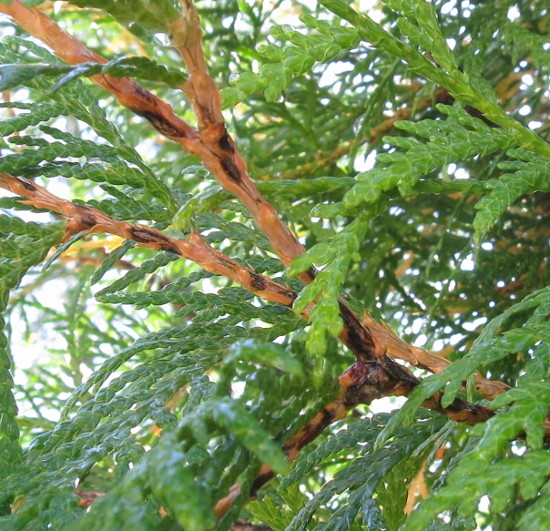
Last week I came to my garden, I was surprised looking at the small thuya. I brought it up from cutting, I cared for it all the time. What did I see that day? Dry yellow foliage and  stems at the foot of the thuja. Looking closely I saw long black lines and spots on the trunk and thin stems. I was very upset.
I should learn more about thuja disease. Reading on internet I've found the Royal Horticultural Society (RHS) site and there is a complete description of this problem. It said that 'Cypress aphid is one of the causes of dieback on conifers. It has become an increasingly problematic on conifer since the 1980s'. 'A useful confirmation of aphid damage is the presence of a black sooty mould on the stems and/or foliage, as there are other causes of dieback on conifers'.


This description was absolutely similar the picture I saw. A black powdery coating of sooty mould developed on the stems and foliage. The lower parts were more severely affected than the top.
'Damage is caused by brown aphids that are active from May to November. They suck sap from the stems and even quite light infestations can have a significant effect. They are difficult to see as their colour matches that of the bark' 


I've taken the pictures to look closely at aphids at home. I learned Cypress aphid often cause a gradual drying up of the foliage, by late summer many of foliage will be brown and dead.
Then I decided to find the active treatment (chemical or natural) against Cypress aphids. Reading different sources I learned some preparations and their analogues in Russia. I've found the insecticide cypermethrin, called 'Intavir' (Интавир) here. There are no natural preparation against this filth.


I did solution as it is said, and sprayed ALL stems and foliage. I had to spray twice, so I repeated it yesterday.  
Here is the result!


Good news: Damaged thuya can recover but it is likely to be a slow process. However I have a hope.

Thursday, September 28, 2017

All The Rivers Run

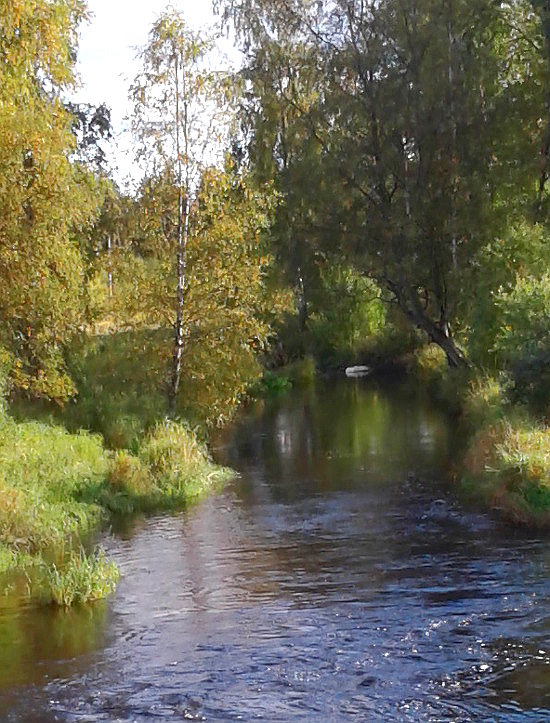
Recalling the ended summer I want to show you small rivers that run in the woods and fields North of St. Petersburg. I like to walk along the river banks, to look at running water, reflections of trees and grasses. This area is not flat, there are many stony places. The rivers have long been laying their beds through rocks and boulders left after the melting of the glacier. Their course is often winding and boulders in the water formed dams and rapids. Water seethes running through the rapids and a lot of air bubbles can be seen on the water surface.
Here are the photos of my summer strolls.


Among the fields and deciduous forests the riverbed becomes wider and the current gets slow and calm. These are wonderful places for fishing, because the fish lives in calm and deep dams. I often notice fishing rods put on the shore.


Fishermen can even show their catch (it's a bream).


At the end of summer the leaves on the trees begin to turn yellow and the berries ripen in the forest along the river bank.
 

At the foot of the tall pines low berry bushes grow. They don't grow tall ones because of frost and snow covers them for several months. At the end of summer and autumn heavy crop ripens in the forest. Here are lingonberry and cranberry.


'All the rivers run' - it's a title of the  miniseries , 1984. It's about the people whose whole life has been gone by the river. Did you see this movie? 

Have a nice day!