Thursday, September 19, 2013

Natural Park In the Majorca Island

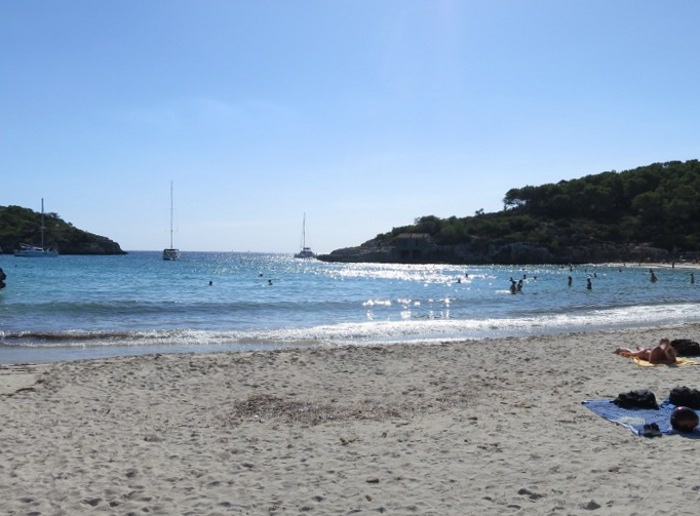
        My vacations in Majorca island have finished. I had pleasant days of the sun and the sea. In one of hot days I went to the Natural park of Mondrago, which is located to the south-east on the rocky shores of the Mediterranean. 


A lot of tourists come to the Mondrago park just to sunbathe and swim. There are two beautiful beaches in the park, with pure white sand and crystal clear water. To reach the beach from the parking they need to overcome a few tens meters of the narrow path along the rocky cliff. 


Although there is no fence along the walkway it does not scare the tourists. They boldly go with baby carriages, inflatable rafts, umbrellas and towels to enjoy the beach. I also passed with the others along the cliff to the beach, bathed in the warm emerald blue water and went to the park. The paths in the park are rocky, steeply rise up and come down. 

 
Everywhere you can see the impact of strong winds and sun on the trees. The soil is poor on the coast, limestone and fertile soil is very thin here. Environmental conditions, such as lack of rain water, the heavy sunshine, the salt in the air and strong winds determine the plant species that can survive. 


They are plants with small, stiff leaves to limit water loss due to evaporatation: rosemary (Rosemarinus officalis), mastic tree (Pistacia lentiscus) and Savin (Juniperus phoenicea), pines (Pinus halepensis) and gatova or broom (Genista lucida). I liked the pine trees those lie along the shoreline, twisted by strong winds. I also found pine trees, growing as a natural bonsai, without effort of a man.


Despite the harsh conditions of survival, I saw herbs, shrubs with berries and I found amazing succulents on the dried swamp.Cones have grown on pines, berries reddened on cotoneasters, seeds matured on herbs.


 Young sprouts of pine trees were creeping along the sand beach. Life goes on! 


Here is my video about Natural park Mondrago:


Monday, September 2, 2013

The Gulf of Finland

        Yesterday I was walking along the shore of the Gulf of Finland and made some pictures. Though we are in early fall now, the sun was shining, it was warm +20 °C. On the other side of the bay new buildings were clearly visible. This is Vasilevsky Island, one of several islands in the Neva River delta.

 
An eastern part of the Baltic Sea is called the Gulf of Finland. The Neva River is very full flowing and connects the deep Ladoga lake and the Gulf of Finland. The huge mass of water gets there. 

 
There are some photos of the Gulf in my archive made ​​in winter and spring. In winter, I walked in the ice and photographed fishermen sitting and waiting for fish (here). It was very cold, but ice fishing enthusiasts were not afraid of frost.


Saint Petersburg is located on the banks of the Neva River and on the shores of the Gulf of Finland. In spring sun warmed hard and ice began to melt fast, the blocks of ice slowly swam into the Baltic Sea. 


The sand on the beach dried up and the water became clear and transparent. Buds appeared on the coastal willow trees. But the snow still stayed between the pine trees and on the sand.


On summer weekends many holiday makers come to the Gulf beaches to swim and sunbathe. Screams, laughter, music was constantly heard, they played with ball, children built castles in the sand. I love to relax on the yellow sandy shores too.  
Yesterday I met some people strolling along the beach, because the water has already cooled off for swimming.


Where do you drive to relax and bathe in a hot day? 
Is there any bay, lake, sea (not swimming pool!) near your home? 
Thank you!


Monday, August 26, 2013

Berries In The Forest


              This is cowberry (or lingonberry), is juicy and tasty wild berry. It's a big harvest in the forest this year. My neighbors gardeners invited me to their company to gather cowberry. You might remember that I had gone with them to the river where they were fishing (here). I love to eat cowberry, it has a sweet-sour taste, is perfectly stored with sugar and is very useful, especially in the cold season.
We went out after breakfast and walked into the forest, a few miles from my summer house. At first we had passed a swamp, where Jerusalem artichoke (Heliánthus tuberósus) grew with yellow flowers. Its rhizome can be eaten, but I had never tried it. On a small lake I've seen ducks, they were hiding.


Our route passed by tall trees. I love to consider high and old trees. They've seen a lot in their long life!


Finally we were in the woods. This was a pine forest, quite clean and dry. I could see many pines in a distance.


Often large granite boulders could be found in such wood. They stayed lying there since a melting glacier passed by thousands years ago. The blueberry bushes grew under the pines. But blueberries have already dropped, there was a little left on the bushes. 

 
The cowberry bushes are not high. I found them around the boulder, among the fallen trunks and in moss. There were a lot of berries. It is necessary to bend down or to squat down to gather cowberry. It is so tasty that the hand with berries moved in my mouth. Oh, no!, it should be collected in a bucket!


Having come back to the garden, I put the bucket with berries and took the picture.


Do you like cowberry (or lingonberry)? When did you gather it and where? Do you make cowberry jam?
Thank you!