Tuesday, May 19, 2020

Art of the Jewel


Today I'd like to show you the collection of jewel. The author is Paula Crevoshay, she is a master of her craft, artist and designer of many wonderful jewels. The richly colored they are the product of her deep understanding of mineralogy, gemology, the work of carving and cutting stones.


Minerals and gems she uses in her work are naturally occurring inorganic solids made of chemical elements that have bounded together in a specific patterns. The most common gems that Crevoshay uses are:
gold, 
sapphire (rainbow colors),
tourmaline (green-blue-red),
diamond (steel gray, white, blue, yellow, orange, red, green, pink to purple, brown, and black),
amethyst (pink),
tsavorite (bright green),
ruby (dark red),
rubelite (from red to shocking pink).


Paula Crevoshay is inspired by nature. Therefore her jewelry often takes the form of a plant, insect or animal. Natural processes create minerals, and she cuts, polishes and sets gems in her masterpieces.


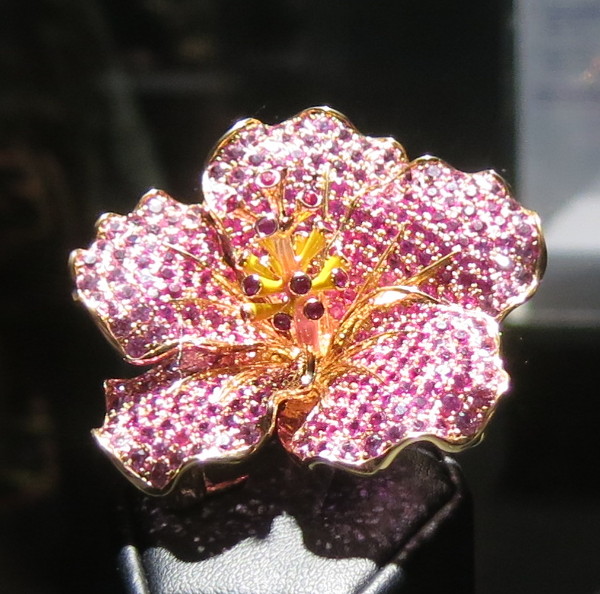
Sapphire Montana was discovered by gold miners curious about the small colored stones clogging up their equipment. It's known for its rainbow array of colors. It took Crivoshay several years to gather enough Montana sapphire to create the pink flower.

 
Main tourmaline has one of the widest rangers of any mineral because of this it was confused with other gems. Main tourmaline is known for its green hue though it can be any color.


This jewelry collection was presented at the Museum of Natural History in Los Angeles in 2019. I hope you enjoyed these amazing things and you probably would have chosen something for yourself :-))

Click to enlarge the photos to watch the jewelry.

Friday, May 8, 2020

Begonia Tuberous

I have two Begonia Tuberous, a white double and a red double ones. For winter time I usually keep Begonia tubers in dry soil pots occasionally watering them. Begonia Tuberous tolerates well winter storage. This year in early March I opened pots with them and saw that several young shoots emerged from the tubers. In April the shoots grew up fast and even gave first flowers indoor. 


Tuberous begonias bloom throughout the summer, mostly in shady spots where few other plants can grow. They are often used as container plants on patios and porches, in hanging baskets and as bedding plants. I always choose a protected windless spot. For most of the day, the plants will be shaded so that the sun does not hurt them. But they need a good indirect light at another time.


I noticed Begonia roots develop from the bottom, sides and top of the tuber, and stems sprout from the top. Once stems have reached 3 - 4 cm, it's time to pot the tubers into larger containers, or in permanent summer tubs.  


I try to accustom the plants to outdoor conditions moving them on a warm day to a shaded,  sheltered place, like a balcony.  At night I bring them back indoor until the temperature has cooled. 
I know Begonia is a tender plant and needs warm weather to be planted in the garden. Therefore I am in no hurry to transfer my plants outdoors. Here it is growing in a container near the pond.


Have you grown Begonias Tuberous before? What is your experience?

Thursday, April 30, 2020

The Fogotten Pietro Canonica

Today I would like to show some of the works by Pietro Canonica that I liked the most. He created many interesting sculptures that I saw at the Villa Borghese in Rome. 
Pietro Canonica was an Italian sculptor, he lived in 1869-1959.
Villa Borghese is a great place with buildings, cottages, sculptures, many plants and flowers, amazing ponds with fish and turtles. One of the buildings houses the Canonica's House-Museum. 
When Canonica gained big success he moving to Rome and participated in important national and international exhibitions in Milan, Venice, Paris, London, Berlin, St. Petersburg.
I was not familiar with this sculptor, and his works were a discovery for me. The pleasant discovery. Some of his works are devoted to portraits of famous people of Europe, of children of noble European families.

The Abyss, marble, 1909 
'The image of the two is a representation of passionate love that drags into its fatal vortex, the abyss. '

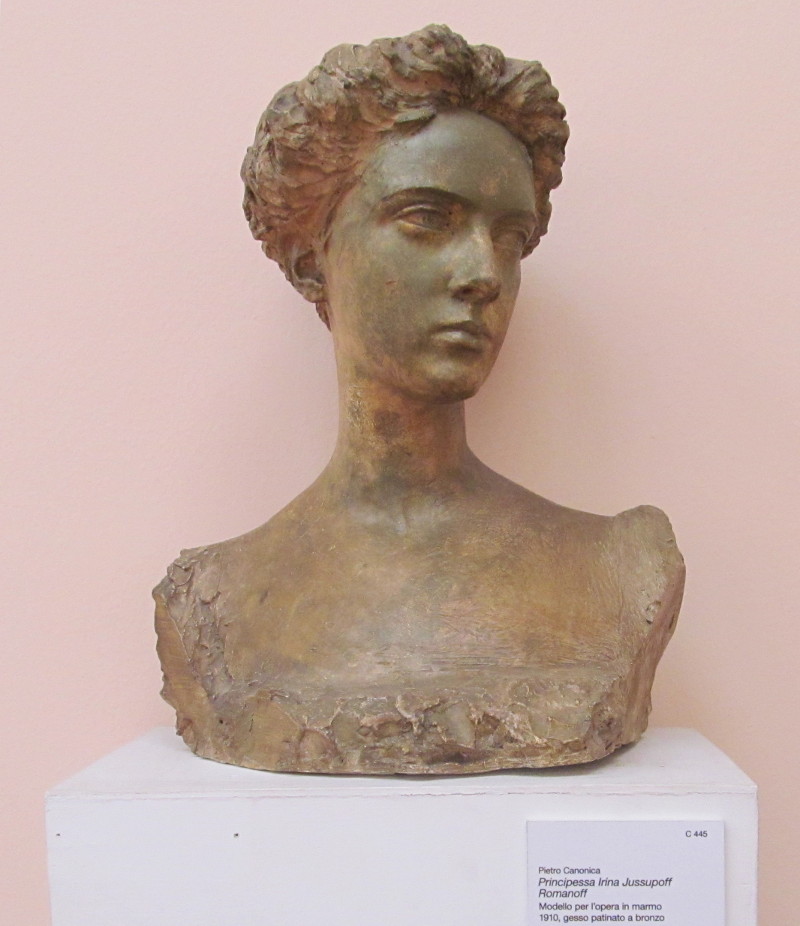
Princess  Irina Yussupov Romanov, bronze 1910


Mario, marble, 1920 

The Conquest of Smyrna, the Monument to Kemal Ataturk, bronze, 1932

The Month of March, marble, 1900

 William Arthur marquis of Tichfield, marble, 1904


St. Paul of Tarsus and a Crucified Christ, marble, 1920


Monument to emperor Alexander II of Russia with portraits and commemorative works, marble, 1904


Modesty, marble, 1920


Two monuments: Alpine soldier and the mule
to mountain warfare cops of the Italian Army, bronze, 1940


In 1937 Canonica managed to obtain the concession to renovate Villa Borghese. In exchange of the promise to donate his artworks to the city of Rome, he was allowed to use the historical building as home and studio, which he repaired and decorated at his own expense. It is believed that Canonica in his portraits was able to capture the psychology of the persons and fix them like in a firm photographic image.
What do you think about these works? Did you like something?