Wednesday, May 29, 2013

My Rhododendrons In Bloom

     The rhododendrons grow in the shady and secluded corner of my garden. These last spring days they started to bloom!


      Here not many gardeners dare on rhododendron cultivating. Because these plants require acidic soil, peat, and do not always tolerate extreme cold.
Previously, I purchased rhododendrons bred in different nurseries. They were strong and beautiful plants, but unfortunately were not suitable to our zone 5a and died in the winter.


A few years ago, here in St. Petersburg the garden center began selling rhododendrons from the Finnish nursery 'Mustila'. Scientists from this nursery bred many hybrids of these bushes. The majority of the 'Mustila' nursery hybrid rhododendrons are hardy, up to -35C, low, so are completely covered with snow in the winter. It's good for their flower buds, plants keep their buds and flower well in the spring.


So I bought a few bushes from 'Mustila' nursery 5-6 years ago. These were varieties "Pohjala's Daughter", "Helsinki Univesity", "Tigerstedt" and others. All my rhododendrons were wintering well, I did not cover them for the winter. In spring, once the snow melts, they straightened their evergreen leaves and prepared to bloom.
I love my rhododendron variety "Pohjola's Daughter" or "Pohjolan Tytar" (in Finnish).  Interestingly, its buds are of cyclamen-red color and flowers are pale purple!


Another variety is my new rhododendron "Peter Tigerstedt." Its buds are like candles, white with black stripes. Flowers open one by one and they are also white with brown speckles.
 

The third blooming rhododendron is "Helsinki University". It's short and round bush with high winter hardiness, its cowberry colored buds open into bright pink flowers.


My other leaved deciduous rhododendrons will bloom a little later, they have large buds and new leaves. So I will continue to talk you about my rhododendrons in bloom.

Read about my trip to the Arboretum Mustila here

Do you have the rhododendrons in your garden? Do they bloom every year or not always?


Wednesday, May 22, 2013

Ismene

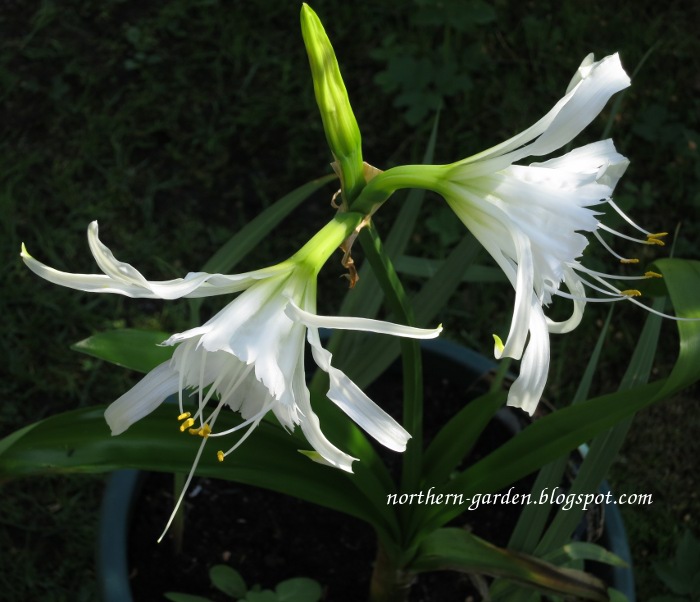
The first time I've read about this plant in January this year, when I got the bulb as a gift. The large bulb was called Ismene festalis (Hymenocallis festalis), unusual flower was depicted in the picture. It's common name is "Spider Lily". I learned that at the top of each flower stalk (height of 45-60 cm) can be up to 6 fragrant white flowers in diameter of 10-15 cm. Minimum temperature for the plant growth is necessary +13 C.
It's  necessary to water the plant sparingly before the appearance of green leaves, and watering has to be stopped when the leaves start to wither in the fall. I decided to grow Ismene in the garden container. Ismene comes from the hot and humid subtropics, where drought lasts for two months. They can be grown outdoors from spring to autumn.


I put the container in a warm place in my greenhouse, planted bulb in the second half of April. Since early May, the container was standing in a sunny spot of the garden. Although it’s written that Ismene usually blooms in the open air in early June, my Ismene bloomed on May 19. The first bud appeared and opened on a high spike.


The next day, a second bud opened. It was a miracle! I've never seen such flowers.


Finally the third bud has opened today at the morning! Flowers smell great. The smell is very pleasant, like the smell of lily of the valley

 What reminds you this? Perhaps antennae of the butterfly?
 And this reminds me of a white swan wings.
 And these are probably dancing ballerinas, their flowing hands in a dance.
However, in early September, I should dig up the bulbs and put Ismene in a pot with slightly damp peat that the roots of bulb would not dry and store it in a cool place. This period of rest is required in order of the plant could bloom again next year.

Did you know this plant? Do you grow it in your garden? How do you store Ismene in cold season?

Wednesday, May 15, 2013

Primrose In My Spring Garden

In the spring when these delicate flowers appear, my garden is illuminated. For a long time people have allocated Primrose (Primula) among many beautiful plants. This is surprising when we recall that most of primulas are modest little plants with small flowers. According to the Old Norse sagas, these primrose flowers are the keys of the Goddess of Fertility, which she opens the spring.


Most of primulas grow wild in Asia, the Himalayas and western China, in wet areas, along the banks of mountain streams and springs. Primroses grow and thrive in such a harsh environment, where other plants can't grow.


Primula has solitary flowers in some species, or the flowers may be collected in inflorescence in other varieties, they are of different colors, monochromatic as well as bi-color, often with the center. Usually primroses bloom in early spring.
For years some species of primulas have been grown indoors as potted plants. Currently it is primula common grown and sold in small containers or baskets.


Moist, well-drained soil that's what they need. I planted the first primroses near the rhododendrons.
Especially primrose requires a lot of moisture in the spring. At this time in the mountains, where they came from, the snow melts and the plants are literally swimming in the water, so they are not afraid of cold spring water.


I love that the primrose does not require much care. The soil should always be moist and friable. In soft ground the roots of young rosettes grow faster. I fertilize my primroses three times in the summer, with other plants.
Most primulas are hardy, they rarely freeze and keep decorative effect even with minimal care.